You can't vibe feels
AI-narrated
A synthetic voice reading the text on this page.
Good publications keep putting a listen option on their articles, and I like it every time I find one. Edison Research put monthly podcast listening at 58% of Americans age 12 and older in January, roughly 167 million people and the highest they have measured.1 Online audio reached 81%. Serious work reaches people by ear now, so I added an AI-narrated reading to every case study on my site.
Almost everything else I hand an agent has an answer it can check by itself. Tests pass or they fail. The page renders or it breaks. Types hold or they do not. The agent writes the code, runs the check, reads the result, and closes that loop without me in it.
A voice reading my work has no such check. The agent generated every second of that audio and could not hear any of it, so it built the whole feature without ever knowing whether the feature was good.
Asking a model with no ears which voice is best gets you a confident coin flip. What it can do well is narrow the field and put it in front of me. It built a page of six voices reading the same passage from a case study, and picking one took a minute. Pacing needed the same treatment. It shipped a default, I listened, and the reading dragged enough that I reached for the playback speed. What fixed it was a knob it exposed for me to set rather than a better guess on its part.
The model reads text through a phonemizer, and that phonemizer mangles words. Domain came out wrong twice before it landed, and fixing it meant finding a respelling that hits the intended sounds, which the machine can verify on paper without hearing anything. It checked candidates against the phonetic output, discarded the ones that were wrong, and synthesized the survivors for me. Narrowing delegates. Judging does not.
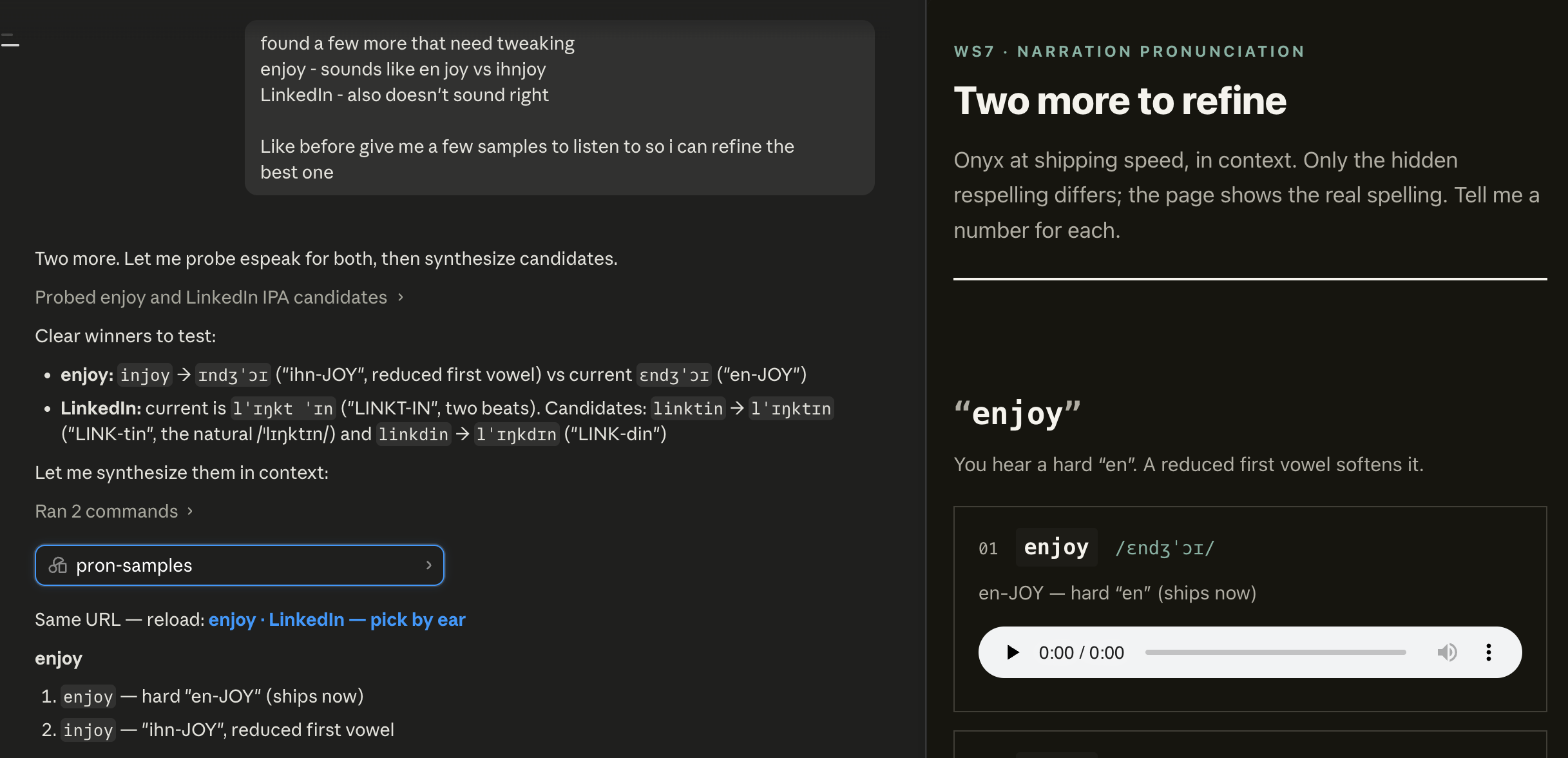
Doing that by hand left me wanting a tool that does not exist yet. A narration feature should go find the words whose pronunciation splits from speaker to speaker, generate a few candidates for each, and ask me to pick. Those picks become primary colors. The voice mixes them and repaints every other word in the article the way I would have said it. Publishers running text to speech already keep custom pronunciation dictionaries, and they still report that a mispronounced name costs them credibility faster than almost anything else.2 They have the correction and are still tuning it by hand.
Agentic coding produces faster than I can review, so the limit is no longer how much I can build. It is how quickly my intuition separates good from not good, and that sharpens only as I learn my own taste. Everything else about this work got cheaper.
The economics of the build still owe you a post of their own. The narration is live on the case studies at munadmahinoor.com, and the feedback on it is shaping how I bring the same thing to these posts next. Press play on one and tell me whether the voice sounds like a person you would want to work with. That is the check I never managed to automate.
Footnotes
-
Edison Research, The Infinite Dial 2026, fielded January 2026. ↩
-
Pugpig, Text-to-speech in publisher apps has shifted from a nice-to-have to a habit-builder, March 2026. ↩